What You Need to Know About Subrogation in Car Accident Claims
What You Need to Know About Subrogation in Car Accident Claims
Subrogation in a car accident claim is the legal process by which an insurance company seeks reimbursement for medical bills or repair costs it paid on your behalf from the settlement or judgment you receive from the at-fault party.
For many accident victims in Boulder, this concept comes as a shock and unwelcome surprise. After months of treating injuries and fighting for a fair settlement, receiving a notice that your health insurer or another carrier wants a portion of that money can feel unfair.
You pay premiums for coverage, yet when you need it most, insurers often assert a “right of recovery” against your compensation. Without aggressive legal advocacy, these demands can significantly reduce the net amount you take home for your pain, suffering, and lost wages.
Understanding the rules governing subrogation car accident claims is vital to protecting your financial recovery. While insurance policies are often dense with contractual language that favors the insurer, both state and federal laws place meaningful limits on when and how subrogation can be enforced.
A knowledgeable Boulder car accident injury attorney from Sloat, Nicholson & Hoover, PC, can identify these protections, challenge improper or overstated liens, and work to maximize the portion of your settlement that stays with you—rather than being redirected back to an insurance company.
Key Takeaways About Why Legal Representation Matters in Subrogation in Car Accident Claims
Colorado law prioritizes your recovery: Under Colorado Revised Statutes § 10-1-135, the made whole doctrine generally requires that you be fully compensated before an insurer can seek reimbursement. Attorneys rely on this protection to challenge subrogation claims when a settlement does not cover the full extent of your damages.
Negotiation reduces insurer demands: A reimbursement or subrogation demand letter is often just the starting point. Lawyers negotiate reductions by leveraging litigation costs, policy limitations, and attorney’s fees – ensuring you retain more of your settlement.
Subrogation rules vary by plan type: Different laws apply to private health insurance, ERISA plans, and government programs such as Medicare. Attorneys identify which rules govern your claim and challenge reimbursement demands that do not comply with the law.
Medical liens require careful resolution: Unresolved medical liens can jeopardize your settlement or future coverage. Legal professionals handle lien negotiations and settlement distributions to safeguard your compensation.
How Subrogation Affects Your Car Crash Injury Settlement
Front-end collision damage — a common starting point for insurance subrogation disputes in Boulder car accident claims.After an accident, seeking immediate medical care is essential—regardless of who caused the crash. In most cases, your health insurance or MedPay coverage under your auto policy pays these initial medical bills.
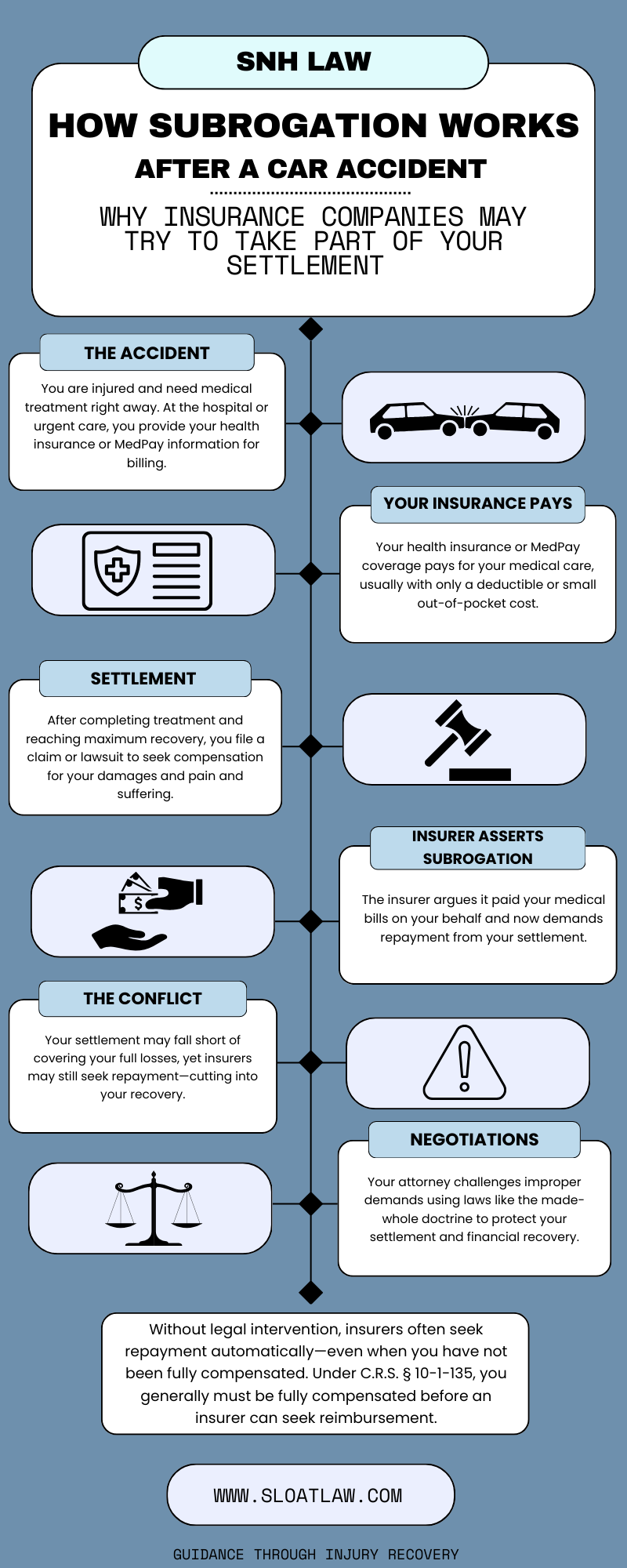
Once you pursue a claim against the at-fault driver, your insurer may assert that it “stepped into your shoes” by covering those expenses and is therefore entitled to reimbursement once compensation is recovered. This is known as the auto insurance subrogation process.
Insurers justify subrogation by arguing against “double recovery.” Their position is that if they paid a $5,000 hospital bill and the at-fault driver later pays you $5,000 for that same expense, you have been compensated twice.
What this argument overlooks is the reality of personal injury claims. Many cases settle for less than their full value due to policy limits, disputed liability, or other constraints. In those situations, subrogation can unfairly shift the financial burden back onto the injured person.
This is where subrogation disputes frequently arise in Boulder car accident cases. For example, if a claim resolves for $50,000 but your health insurer paid $20,000 toward your care, the insurer may attempt to recover that full amount from your personal injury settlement—dramatically reducing what you take home.
A skilled attorney steps in at this point to examine the insurance policy’s subrogation language and applicable laws, determining whether the insurer actually has a legal right to reimbursement or is overreaching beyond what the law allows.
How subrogation unfolds after a Colorado car accident settlement.
What is the “Made Whole” Doctrine in Colorado?
One of the most powerful tools available to accident victims in Colorado is the made-whole doctrine. Codified in Colorado Revised Statutes §10-1-135, this law states that a payer (like an insurance company) cannot seek repayment from your settlement until you have been “made whole” for your damages.
In many serious accidents, the at-fault driver carries only the minimum liability limits – coverage that often falls far short of fully compensating victims for medical expenses, lost wages, pain and suffering, and permanent impairments. In such scenarios, the injured person has not been made whole.
Attorneys leverage this statute to block or significantly reduce Colorado insurance subrogation demands. If the settlement funds are insufficient to cover your total losses, the law often mandates that you keep the money rather than reimburse the insurance company.
Insurance adjusters, however, rarely volunteer this information. It requires an assertive legal advocate to cite the statute and demand that the insurer drop or reduce its claim.
Subrogation Car Accident Claim FAQ
What is a subrogation waiver in an insurance policy?
A subrogation waiver can limit or eliminate an insurer’s ability to seek reimbursement from your settlement. Attorneys review policy language to identify these waivers or challenge ambiguous terms, ensuring your rights are protected.
Why is it important to audit a lien before paying it?
Health insurers often include unrelated or excessive charges in their reimbursement demands. Lawyers carefully audit liens to remove these errors, reducing the amount you owe and preserving more of your settlement.
How does the common fund doctrine affect subrogation claims?
The common fund doctrine requires insurers to share the cost of legal fees when they benefit from your settlement. Attorneys apply this principle to reduce the insurer’s lien, maximizing your net recovery.
Can subrogation claims be negotiated?
Even valid subrogation claims can often be reduced through negotiation. Attorneys leverage legal defenses and the risk of litigation to secure compromises that protect your financial recovery.
Protect Your Auto Accident Settlement With the Help of Sloat, Nicholson & Hoover, PC
Robert Hoover
Motor Vehicle Accident Lawyer in Boulder
Without legal guidance, many accident survivors unknowingly overpay in response to reimbursement demands. These companies often take advantage of the fact that most people are unfamiliar with their rights under Colorado subrogation laws or the differences between equitable subrogation and contractual obligations.
At Sloat, Nicholson & Hoover, PC, the focus is always on protecting your financial recovery now and in the future. We handle insurance reimbursement disputes with a client-centered approach, working to safeguard the compensation meant to support your recovery.
If you’re unsure whether a subrogation demand is accurate or if you might be paying back money that should remain yours, contact Sloat, Nicholson & Hoover, PC today to discuss your case during a free case evaluation.
Legal Resources About Motor Vehicle Accident Claims in Colorado
To help you better understand the nuances of insurance coverage and liability in Colorado, our attorneys have curated the following resources. These articles provide trusted insights into issues that directly impact your ability to recover fair compensation after another driver’s negligence causes you harm:



 Subrogation in a car accident claim is the legal process by which an insurance company seeks reimbursement for medical bills or repair costs it paid on your behalf from the settlement or judgment you receive from the at-fault party.
For many accident victims in Boulder, this concept comes as a shock and unwelcome surprise. After months of treating injuries and fighting for a fair settlement, receiving a notice that your health insurer or another carrier wants a portion of that money can feel unfair.
You pay premiums for coverage, yet when you need it most, insurers often assert a “right of recovery” against your compensation. Without aggressive legal advocacy, these demands can significantly reduce the net amount you take home for your pain, suffering, and lost wages.
Understanding the rules governing subrogation car accident claims is vital to protecting your financial recovery. While insurance policies are often dense with contractual language that favors the insurer, both state and federal laws place meaningful limits on when and how subrogation can be enforced.
A knowledgeable Boulder car accident injury attorney from Sloat, Nicholson & Hoover, PC, can identify these protections, challenge improper or overstated liens, and work to maximize the portion of your settlement that stays with you—rather than being redirected back to an insurance company.
Subrogation in a car accident claim is the legal process by which an insurance company seeks reimbursement for medical bills or repair costs it paid on your behalf from the settlement or judgment you receive from the at-fault party.
For many accident victims in Boulder, this concept comes as a shock and unwelcome surprise. After months of treating injuries and fighting for a fair settlement, receiving a notice that your health insurer or another carrier wants a portion of that money can feel unfair.
You pay premiums for coverage, yet when you need it most, insurers often assert a “right of recovery” against your compensation. Without aggressive legal advocacy, these demands can significantly reduce the net amount you take home for your pain, suffering, and lost wages.
Understanding the rules governing subrogation car accident claims is vital to protecting your financial recovery. While insurance policies are often dense with contractual language that favors the insurer, both state and federal laws place meaningful limits on when and how subrogation can be enforced.
A knowledgeable Boulder car accident injury attorney from Sloat, Nicholson & Hoover, PC, can identify these protections, challenge improper or overstated liens, and work to maximize the portion of your settlement that stays with you—rather than being redirected back to an insurance company.